
Cleanroom-compatible, adhesive-free thermoplastic assembly for IV sets, filters, catheters, and surgical instrument components.
Why Medical Device Manufacturers Choose Ultrasonic Welding
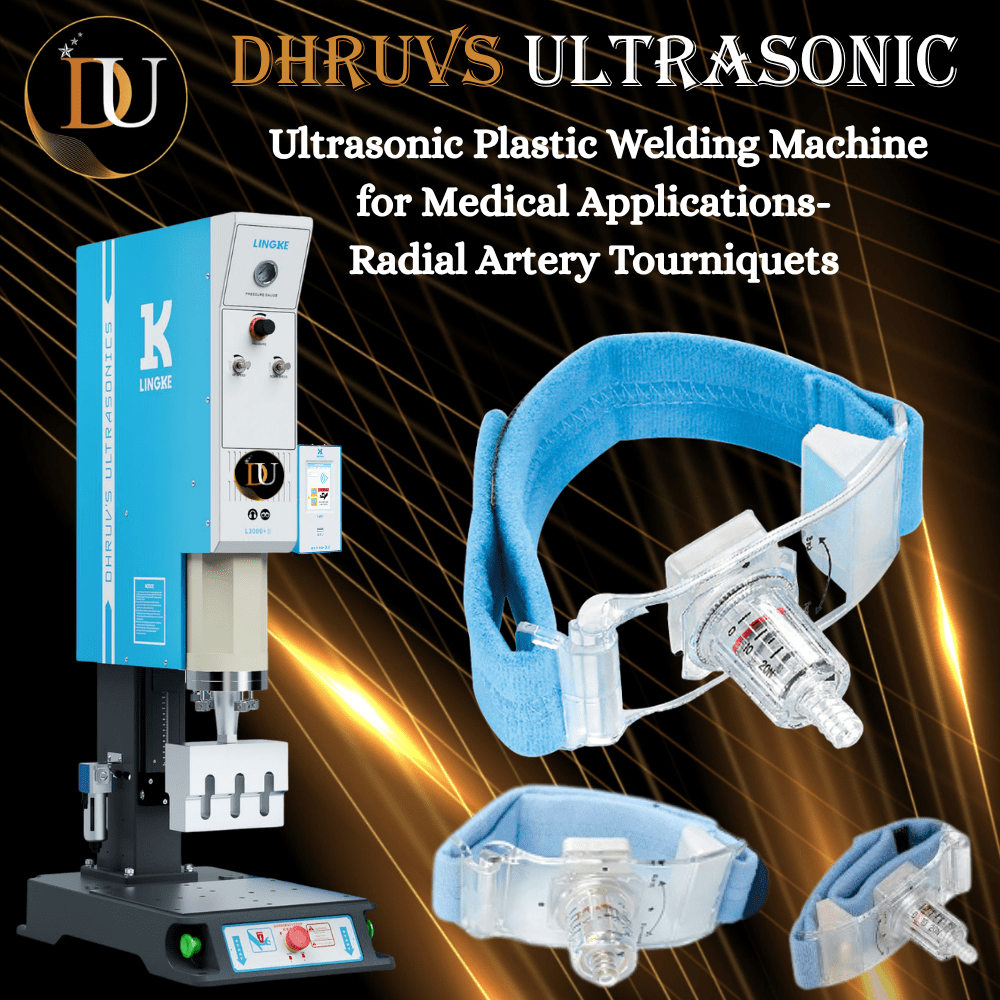
Medical devices demand joints that are strong, repeatable, and free of contaminants. Ultrasonic plastic welding meets all three requirements without adhesives, solvents, or fasteners — making it one of the most widely used joining methods in disposable and reusable medical device manufacturing today.
At Dhruv’s Ultrasonics, we design and supply ultrasonic welding systems specifically configured for the tolerances, materials, and cleanroom conditions that medical production lines require.
Why it matters for medical applications:
- No contamination risk — no glue residue, solvent vapor, or fastener particulates entering a sterile assembly
- Hermetic, leak-proof seals — critical for fluid-handling components like IV sets and blood filters
- Process repeatability — digitally controlled weld parameters (time, energy, depth, power) produce consistent results across high-volume runs, which supports validation and quality documentation
- Fast cycle times — welds complete in fractions of a second, supporting high-throughput production without sacrificing precision
- Compatible with cleanroom environments — no fumes, dust, or curing time
How Ultrasonic Welding Works
Ultrasonic welding uses high-frequency mechanical vibration — typically in the 20 kHz to 40 kHz range for medical-grade components — transmitted through a precision tool called a horn (or sonotrode). Under controlled pressure, this vibration generates localized frictional heat exactly at the joint interface. The plastic melts only where the parts meet, fuses, and forms a permanent molecular bond as it cools.
Because the heat is confined to the joint line, surrounding material — and any sensitive components nearby, such as filter media or sensor elements — is not thermally affected.
Typical medical-grade configuration:
| Parameter | Typical Range for Medical Components |
|---|---|
| Frequency | 20 kHz – 40 kHz (higher frequencies for thin-walled, delicate parts) |
| Weld trigger mode | Time, Energy, or Depth/Distance mode for tight tolerance control |
| Amplitude control | Adjustable (10%–100%) to protect delicate internal geometries |
| Horn material | Titanium or hardened steel, custom-machined to part geometry |
| Cycle time | Typically under 1 second per weld |
Applications in Medical Device Manufacturing
| Component | What’s Welded | Why Ultrasonic Welding Fits |
|---|---|---|
| IV administration sets | Drip chambers, connectors, fluid line junctions | Hermetic seal prevents leaks and air ingress; no adhesive contact with fluid path |
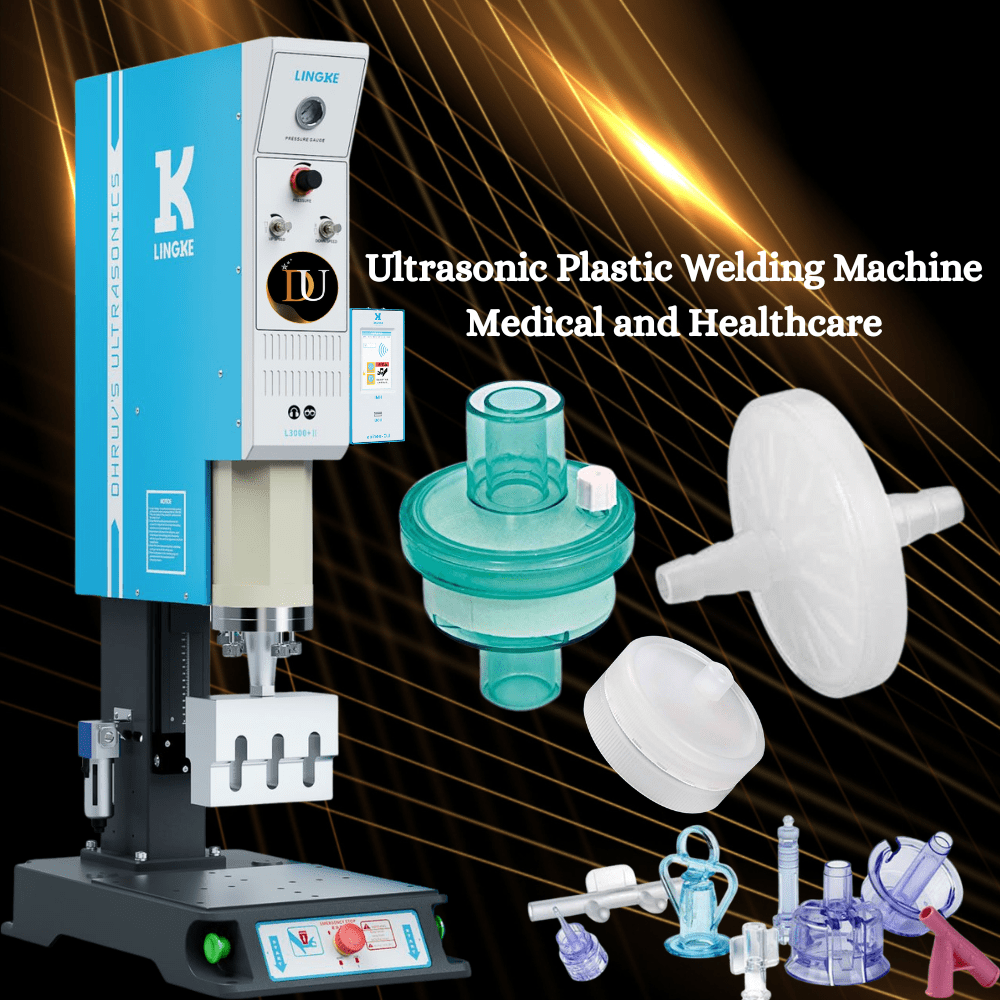
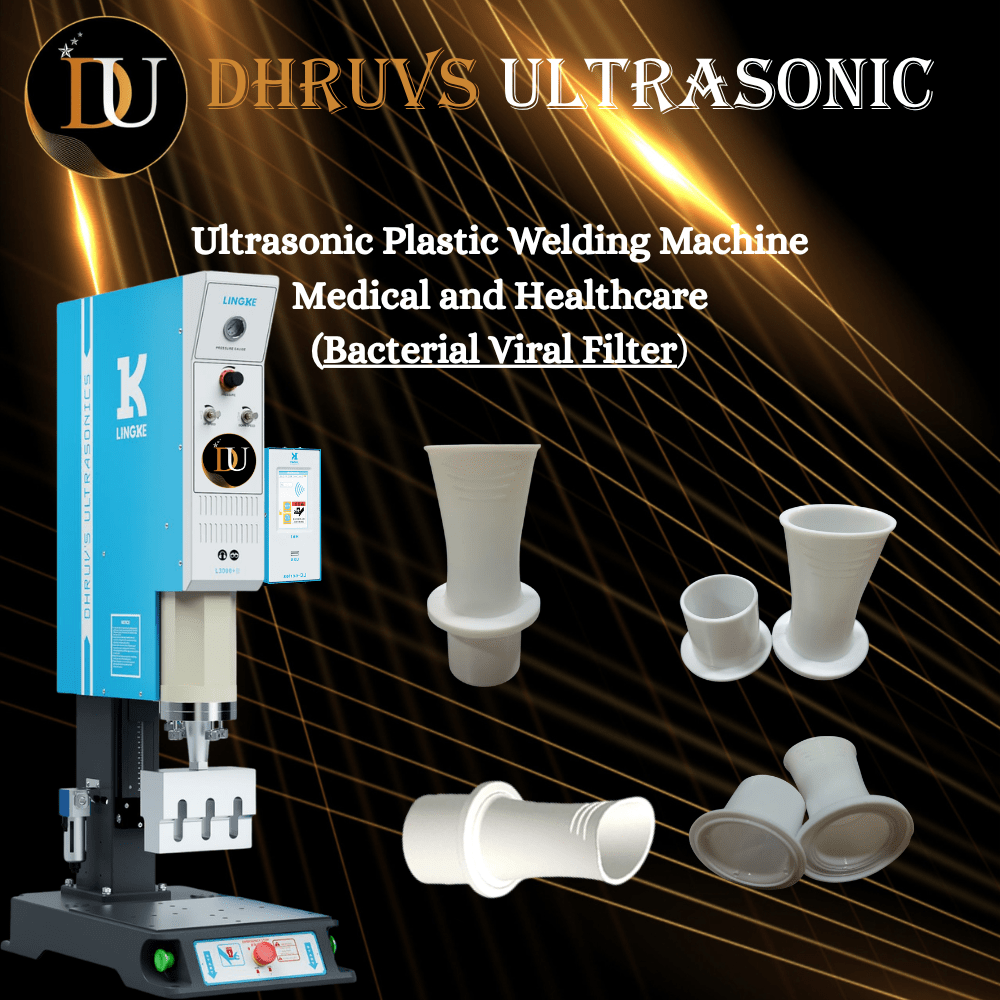
| Blood and respiratory filters | Filter housings, end caps, membrane seals | Clean weld line preserves filtration integrity without chemical interference |
| Surgical instrument housings | Handle assemblies, disposable instrument casings | Strong structural bond suited to single-use, sterilizable designs |
| Catheters and fluid connectors | Hub-to-tube joints, luer connectors | Precision depth control protects narrow-bore geometries |
| Diagnostic cartridges | Sealed reagent or sample chambers | Contaminant-free seal supports assay accuracy |
| Face masks and PPE | Ear loop welding, filter layer bonding, edge sealing | High-speed, adhesive-free bonding suited to high-volume disposable production |
Material Compatibility
Ultrasonic welding works with a range of medical-grade thermoplastics, including:
- PP (Polypropylene) — common in syringes, IV components, filter housings
- ABS — rigid housings, diagnostic device casings
- PC (Polycarbonate) — clear components requiring visual inspection, such as drip chambers
- PVC — tubing and flexible fluid-path components
- PE (Polyethylene) — flexible packaging and certain fluid connectors
Weldability depends on resin compatibility, wall thickness, and joint design — our engineering team reviews part drawings before recommending horn design and weld parameters.
Built for Regulated Production Environments
Medical device manufacturing runs under tighter scrutiny than most other sectors. Our machines are built to support — not complicate — that environment:
- Cleanroom-compatible operation — no smoke, fumes, or particulate-generating consumables
- Repeatable, documentable weld parameters — supports process validation (IQ/OQ/PQ) workflows your quality team manages internally
- Digital parameter logging — available on select models for traceability requirements
- Custom sonotrode (horn) design — engineered around your part’s exact geometry to protect tight tolerances and delicate features
We supply the welding equipment and tooling; biocompatibility testing (e.g., ISO 10993) and quality system certification (e.g., ISO 13485) remain the responsibility of your organization’s design and regulatory teams, as these are device- and material-specific determinations.
Frequently Asked Questions
Is ultrasonic welding safe for use in cleanroom medical manufacturing?
Yes. Ultrasonic welding produces no smoke, fumes, or chemical byproducts. Because there are no adhesives or solvents involved, it’s widely used in cleanroom-classified medical device assembly lines.
Can ultrasonic welding be used on flexible tubing and thin-walled parts?
Yes, with the right frequency and amplitude settings. Thinner, more delicate components typically use higher frequencies (35–40 kHz) and reduced amplitude to avoid stress or deformation. Our team configures parameters based on your part’s wall thickness and geometry.
Does ultrasonic welding leave any residue in the fluid path?
No. The weld is a direct molecular fusion of the two plastic surfaces — there’s no added material, adhesive, or filler introduced into the joint.
Can weld parameters be made repeatable enough for medical process validation?
Yes. Digitally controlled machines can run in time, energy, or depth mode with parameter logging on select models, which supports the repeatability documentation typically required in IQ/OQ/PQ validation processes.
What’s the difference between ultrasonic welding and heat-staking or adhesive bonding for medical parts?
Ultrasonic welding is faster (sub-second cycle times), introduces no foreign material into the joint, and produces a stronger, more uniform bond than adhesive methods — without the curing time adhesives require or the broader heat-affected zone of heat-staking.
Do you provide custom tooling for unique medical part geometries?
Yes. Our engineering team designs and machines custom horns (sonotrodes) and fixtures to match your part’s exact drawing, which is particularly important for small, delicate, or irregularly shaped medical components.
Work With Our Engineering Team
Every medical component has different tolerances, wall thicknesses, and validation requirements. Share your part drawing and we’ll recommend the right frequency, horn design, and weld mode for your application.
📞 +91 9650004416, 17, 18
📧 sales@dhruvsultrasonics.com
📍 B-140, DDA Sheds, Okhla Phase 1, New Delhi – 110020
📍 1278/3, NR Bahirwade Chembars, Mohannagar, Chinchwad, Pune – 411019

This page is for general guidance on ultrasonic welding technology and its applications in medical device manufacturing. Material selection, biocompatibility testing, and regulatory compliance (including ISO 13485 and ISO 10993) are determined by your organization’s design and quality teams based on your specific device and intended use.