
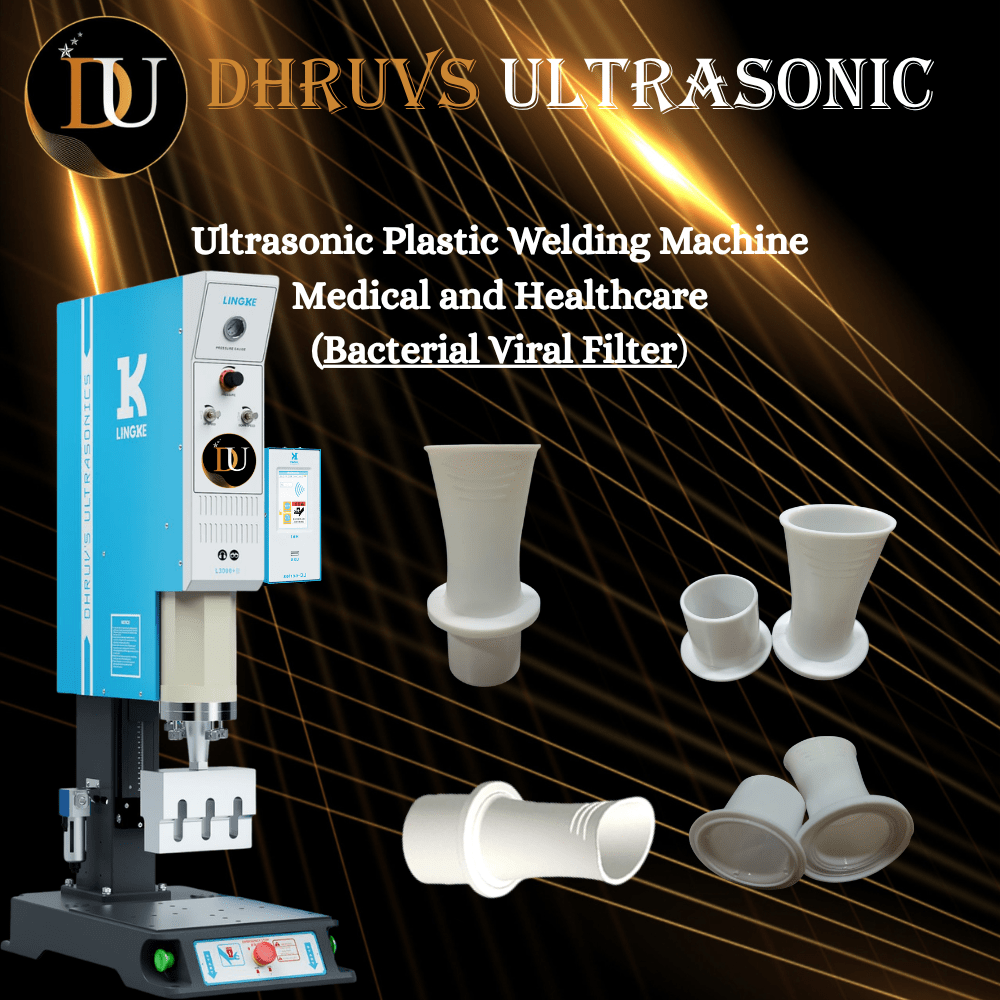
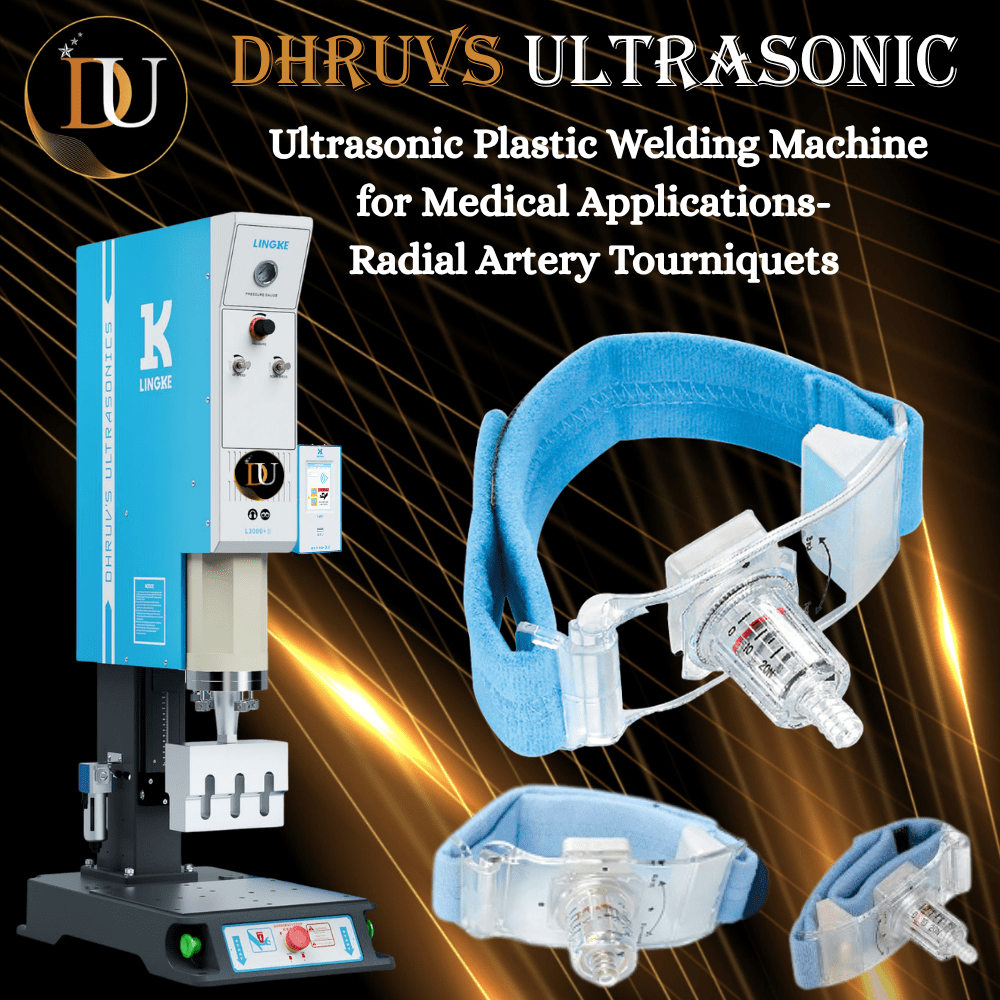
An ultrasonic plastic welding machine for medical application can directly affect product safety and speed. It also affects how ready you are for an audit. Medical device makers need joints that are clean, leak-proof, and the same every time. Because of this, ultrasonic welding is now a top choice. In this guide, we explain how the process works. We also cover where it fits in medical production, and what to check before you buy.
What Is Ultrasonic Plastic Welding?
Ultrasonic plastic welding uses fast mechanical vibration, usually between 20 kHz and 40 kHz, to join two plastic parts. A precision tool called a horn, also known as a sonotrode, presses down on the parts. As it presses, it vibrates fast. As a result, friction builds up right at the joint line. This friction then makes heat. Because the heat stays only at the contact point, the plastic melts in that one spot and nowhere else. Once the material cools, it forms a single, solid bond.
No glue is used here. No solvent is used either. In fact, no screws or clips are needed at all. As a result, you get a fast, clean, and strong joint. This is exactly why the process has become a standard choice across medical manufacturing.
Why Medical Manufacturers Choose This Process
A reliable ultrasonic plastic welding machine for medical application offers several advantages that other joining methods simply cannot match.
First, it avoids contamination, since there is no adhesive residue and no solvent vapor near the line. Second, it creates hermetic seals. This matters for any part that carries fluid or air, such as a drip chamber or filter housing. Third, it supports repeatability. Digital controls let operators fix the same weld time, energy, or depth across thousands of cycles.
Fourth, the process is fast — most welds finish in under one second. Finally, it suits cleanroom settings well, since no curing time is needed and fumes are not a concern. As a result, the process leaves behind no loose particles either.
Because of these factors, hospitals and device assemblers increasingly rely on ultrasonic welding. So do contract manufacturers who must meet strict cleanliness and performance standards.
How the Technology Works, Step by Step
Understanding the basic steps helps when you select the right machine for your part. Generally, the process follows four steps.
- Part placement. First, the two plastic parts are set in a fixture, which holds them in exact alignment.
- Horn contact. Next, the sonotrode lowers and touches the top part under controlled pressure.
- Vibration and melt. Then, the horn vibrates at the chosen frequency. Friction builds at the joint, so the plastic begins to melt right at that line.
- Cooling and bond formation. Finally, pressure holds briefly as the melted plastic sets, which forms a lasting bond.
Because the heat stays in one place, nearby parts are not affected at all. This includes sensors and filter membranes close to the joint.
Applications in Medical Device Manufacturing
Ultrasonic welding supports a wide range of medical parts. Below are some of the most common uses.
| Component | What Gets Welded | Why It Works Well |
|---|---|---|
| IV administration sets | Drip chambers, connectors, line junctions | Hermetic seal prevents leaks and air ingress |
| Blood and respiratory filters | Filter housings, end caps | Clean weld preserves filtration accuracy |
| Surgical instrument housings | Handles, disposable casings | Strong bond suited to single-use designs |
| Catheters and connectors | Hub-to-tube joints, luer fittings | Precise depth control protects narrow parts |
| Diagnostic cartridges | Sealed sample chambers | Contaminant-free seal supports test accuracy |
| Face masks and PPE | Ear loops, filter layers, edge seals | High-speed bonding for large production runs |
Each use needs slightly different frequency, amplitude, and pressure settings, since these depend on part thickness and shape. This is exactly why machine setup and tool design matter just as much as the machine itself.
Material Compatibility
Not every plastic welds equally well. Because of this, manufacturers typically use the following materials for medical parts:
- Polypropylene (PP) for syringes, IV parts, and filter housings
- ABS for rigid diagnostic device cases
- Polycarbonate (PC) for clear drip chambers and parts that need visual checks
- PVC for tubing and flexible fluid-path parts
- Polyethylene (PE) for flexible packaging and certain connectors
If you are not sure your material and part design will work well together, send the part drawing to your supplier first, before you order a machine.
What to Look for When Choosing a Machine
Several practical factors decide whether a machine will work well in a medical setting.
Frequency range. Higher frequencies, such as 35 kHz or 40 kHz, suit thin or delicate parts. Lower frequencies, such as 15 kHz or 20 kHz, suit thick or large parts instead.
Control mode. Time, energy, and depth modes each give a different level of control. For tight-tolerance medical parts, depth mode often works best.
Amplitude control. Because internal features can be delicate, adjustable amplitude helps protect them from stress during the weld.
Custom tooling. A horn machined to match your exact part shape gives more even welds than a stock horn does.
Parameter logging. Some machines save weld data on their own, which helps with quality checks and validation work later.
Cleanroom fit. Before you buy, make sure the machine does not give off dust or fumes that could harm a controlled space.
You can review our detailed ultrasonic plastic welding machine specifications page for frequency and power options. Alternatively, browse our full product catalogue for a side-by-side comparison.
A Note on Compliance
Manufacturers often ask whether ultrasonic welding “meets medical standards.” Here is the honest answer: the welding process itself is widely accepted across regulated facilities.
However, meeting frameworks such as ISO 13485 is a different matter. So is passing biocompatibility tests under ISO 10993. Both depend on your material choice, your validation steps, and your quality system overall. It does not depend on the welding equipment alone. That said, a good supplier will still help your validation work. They do this with steady, repeatable settings and clear records. Even so, the regulatory duty stays with your own design and quality team.
For more background on quality systems in manufacturing, the ISO 13485 standard overview is a useful starting reference.
Common Questions About Ultrasonic Welding for Medical Devices
Is this process safe for cleanroom use? Yes. There is no adhesive, solvent, or open flame involved. Because of this, ultrasonic welding is one of the cleanest joining methods for controlled spaces.
Can thin or flexible parts be welded without damage? Yes, although it depends on the settings used. Specifically, higher frequencies combined with lower amplitude usually protect thin or delicate parts well.
Will the weld leave residue inside a fluid path? No, because the bond forms only from the plastic itself melting together. As a result, there is no added material left behind.
Is the process repeatable enough for validation work? Yes, particularly with digital machines, since they log time, energy, and depth data across each cycle.
Final Thoughts
Picking the right ultrasonic plastic welding machine for medical application really comes down to one thing. You must match frequency, control mode, and tooling to your part’s exact shape and material. The technology itself is proven, fast, and clean. Even so, the results still depend heavily on correct setup and proper horn design.
So, are you evaluating equipment for a new or existing medical line? If so, review your part drawings with an experienced supplier first. As a result, this one step alone can save time and cut rework later.
To discuss your specific application, visit our contact page or call +91 9650004416.