
Ultrasonic Welding Machine: The Complete Guide to Working, Types, Uses & Price
What Is an Ultrasonic Welding Machine?

An ultrasonic welding machine is industrial equipment that joins thermoplastic materials by converting high-frequency electrical energy into mechanical vibration. Rather than relying on adhesives solvents or fasteners the machine generates localized frictional heat at the joint between two plastic parts, melting them just enough to fuse together when pressure is applied. Once the vibration stops, the molten interface cools and solidifies within a fraction of a second, creating a permanent, often nearly invisible bond.
Because the process produces no fumes, no curing wait time, and no foreign material at the joint, ultrasonic welding machines have become standard equipment across automotive, medical device, packaging, electronics, and textile manufacturing. A related category of equipment, the ultrasonic metal welding machine, uses the same vibrational principle to join non-ferrous metals such as copper and aluminum, commonly seen in EV battery packs and wiring harnesses, though plastic welding remains the more common application.
How Does an Ultrasonic Welding Machine Work?
At its core, an ultrasonic welding machine turns electricity into precisely controlled vibration, then applies that vibration through a tool that contacts the parts being joined.
Key Components
- Ultrasonic generator (power supply) – converts standard AC current into a high-frequency electrical signal, typically in the 15 kHz to 40 kHz range.
- Transducer (converter) – usually a piezoelectric stack that converts the electrical signal into mechanical vibration at the same frequency.
- Booster – amplifies or reduces the vibration amplitude before it reaches the horn, depending on the weld requirement.
- Horn (sonotrode) – the tool that physically contacts the plastic part and transfers vibration into it; horns are custom-shaped for each part geometry.
- Press/stand – a pneumatic or servo-driven mechanism that lowers the horn onto the parts with controlled force.
- Fixture/anvil – holds the lower part steady and aligned during welding.
- Control system – sets and monitors weld time, pressure, and amplitude, often with real-time graphs for quality control.
The Welding Sequence
- The two plastic parts are positioned in the fixture, usually with a small raised ridge (called an energy director) molded into one part at the joint line.
- The horn descends and applies controlled pressure against the top part.
- Ultrasonic vibration is triggered for a fraction of a second to a few seconds, depending on part size and material.
- Friction at the energy director generates intense localized heat, melting the plastic at the interface while the rest of the part stays largely unaffected.
- Vibration stops, but pressure is held briefly so the melted plastic solidifies into a single fused joint.
- The horn retracts and the finished, welded part is removed.
The entire cycle typically takes well under five seconds, which is why ultrasonic welding machines are so widely used in high-volume manufacturing.
Types of Ultrasonic Welding Machines
Manufacturers generally choose between three broad categories, based on production volume and part complexity.
Handheld Ultrasonic Welding Machine
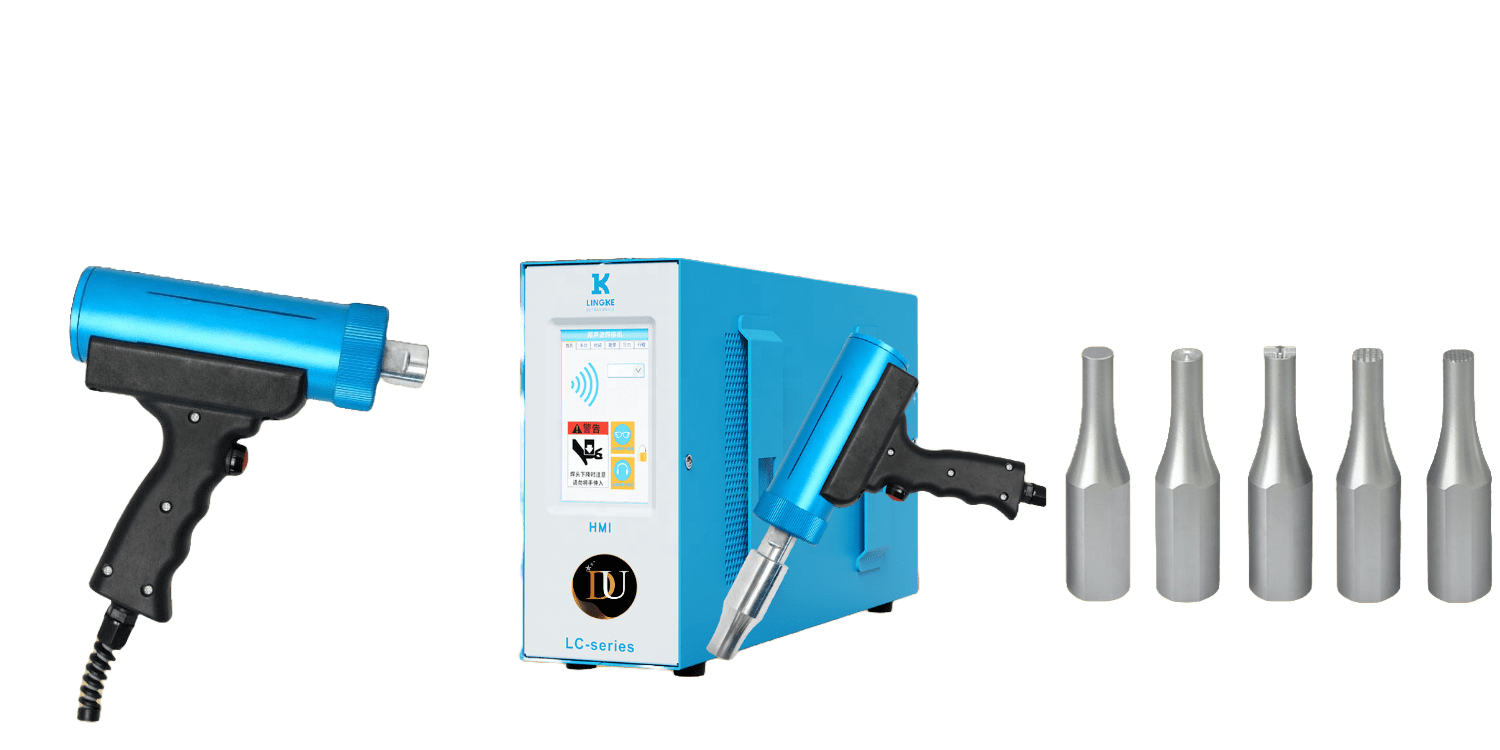
Lightweight and portable, handheld units are designed for on-site repairs, small-batch production, and applications like spot-welding mask straps or automotive bumper repairs. They typically run on lower power, from a few hundred watts up to around 2,000 W, and operate at higher frequencies (28 kHz–40 kHz), making them suitable for smaller, delicate joints rather than large structural welds.
Bench-Top / Desktop Ultrasonic Welding Machine
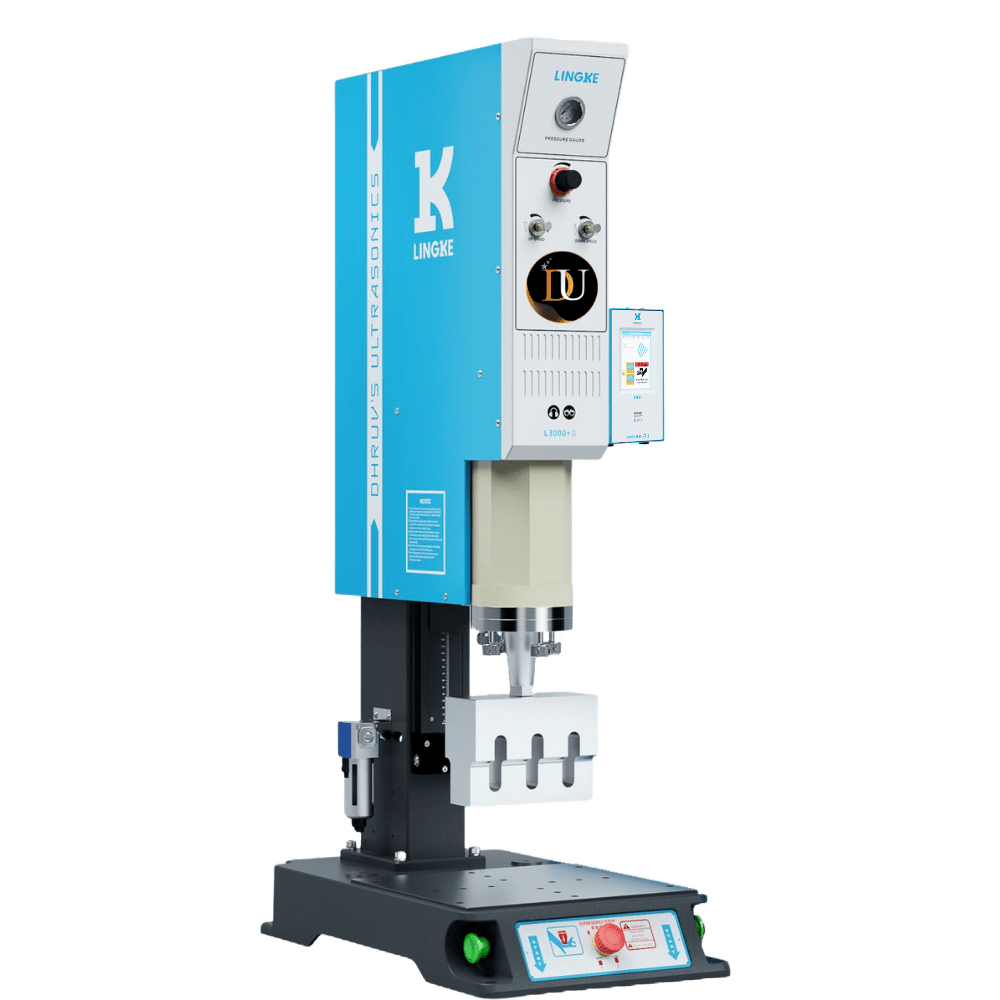
These stationary units sit on a workbench and use a pneumatic or servo press to apply consistent pressure. They strike a balance between precision and affordability, making them popular with mid-volume manufacturers, prototyping labs, and quality-control departments that need repeatable results without a fully automated line.
Automatic / Inline Ultrasonic Welding Machine
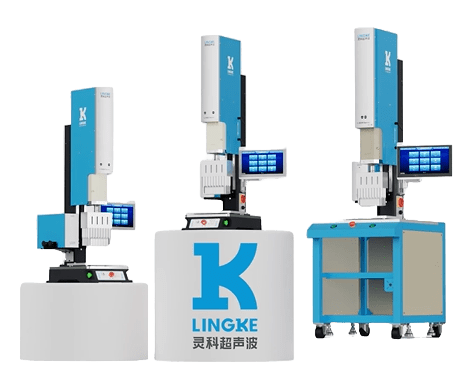
Built for continuous, high-volume production, automatic systems integrate robotic loading and unloading, servo-controlled presses, and data logging for every weld cycle. These are common on automotive and electronics assembly lines where thousands of identical parts need to be welded per shift with traceable quality records.
It’s also worth distinguishing ultrasonic plastic welding machines from ultrasonic metal welding machines. Both rely on vibration, but metal welding machines typically use lower frequencies and higher clamping force to create solid-state metallurgical bonds between metals like aluminum and copper, rather than melting a thermoplastic interface.
Applications of Ultrasonic Welding Machines Across Industries
- Automotive: dashboards, tail lamp housings, air filter housings, interior trim panels, and wiring harness components.
- Medical & Pharmaceutical: IV sets, catheters, blood filters, respiratory masks, and blister packaging that require a contamination-free, sterile seal.
- Packaging: sachets, pouches, blister packs, and tamper-evident seals where speed and an airtight bond matter.
- Electronics & Appliances: battery enclosures, connector housings, and casings for small appliances and consumer electronics.
- Textiles & Non-Wovens: face masks, hygiene products, and technical fabrics joined without stitching, useful where needles would compromise the material.
- Toys & Consumer Goods: battery compartments, housings, and small assembled components that need a secure, tamper-resistant seal.
Materials Compatible With Ultrasonic Welding
Most thermoplastics can be ultrasonically welded, though amorphous plastics generally weld more easily than semi-crystalline ones because they soften gradually rather than melting at a sharp point. Commonly welded materials include ABS, polycarbonate (PC), polystyrene (PS), acrylic (PMMA), PVC, and various nylons, while polypropylene (PP) and polyethylene (PE) can also be welded successfully with the right amplitude and energy director design. Two different plastics will generally only bond well if they are chemically compatible, which a supplier or applications engineer can usually confirm before tooling is built.
Advantages of Ultrasonic Welding Machines
- Extremely fast cycle times, often under a few seconds per weld.
- No adhesives, solvents, or mechanical fasteners required, keeping the process clean and reducing material costs.
- Strong, frequently hermetic (airtight) seals suitable for medical and packaging use.
- Lower energy consumption compared to other heat-based welding methods, since heat is generated only at the joint.
- Easy to automate for consistent, high-volume production.
- Repeatable quality, since weld time, pressure, and amplitude can be programmed and monitored.
Limitations and Things to Consider
- Each part geometry typically needs a custom-designed horn and fixture, adding upfront tooling cost.
- Best suited to small-to-medium joints; very large or deeply contoured parts may need multiple horns or a different joining method.
- Not all plastic combinations are compatible; dissimilar or incompatible polymers won’t form a strong bond.
- Initial equipment investment is higher than basic adhesive or fastener-based assembly, though it often pays back through speed and labor savings.
- Weld parameters need careful tuning to the specific material and energy director design to avoid under- or over-welding.
Ultrasonic Welding Machine Price in 2026 (Cost Factors)
Pricing varies widely based on power, frequency, automation level, and brand. As a general, approximate guide:
- Handheld units: roughly $300–$2,000
- Bench-top/manual press systems: roughly $2,000–$10,000
- Fully automated or inline systems: roughly $10,000–$50,000 and up
These ranges are indicative only. Actual pricing depends on the supplier, region, certifications, and any custom tooling required, so it’s worth requesting a formal quote for your specific application. A few factors influence where a machine falls in this range:
- Frequency and power rating: lower-frequency (15 kHz) machines used for larger parts tend to cost more than higher-frequency units for small parts.
- Brand positioning: established names like Branson, Herrmann, Dukane, and Rinco are typically priced at a premium compared to budget manufacturers based in China.
- Automation level: manual presses cost far less than robotic, inline systems with data logging.
- Custom tooling: horns and fixtures designed for a specific part add to the total project cost beyond the base machine price.
- After-sales support: warranty length, spare-parts availability, and technical support affect total cost of ownership.
Top Ultrasonic Welding Machine Brands & Manufacturers
- Branson (Emerson) – a long-established US brand widely used across automotive and medical manufacturing.
- Dukane – known for precision systems used in medical device and packaging applications.
- Herrmann Ultrasonics – a German manufacturer recognized for its HiQ product line and process-control software.
- Rinco Ultrasonics – a Swiss manufacturer specializing in both welding and ultrasonic cutting systems.
- Sonics & Materials – a US-based supplier offering everything from handheld units to bench-top presses.
- Budget and OEM manufacturers based in China – offer more cost-effective machines, often suitable for small businesses or lower-volume production.
How to Choose the Right Ultrasonic Welding Machine
- Identify the material and part geometry first, since this determines frequency, power, and horn design.
- Decide the required weld strength and whether an airtight or hermetic seal is necessary, which is common in medical and packaging applications.
- Estimate production volume: low-volume or repair work suits handheld or bench-top machines, while high-volume lines justify automated systems.
- Match the frequency to part size: lower frequencies (15–20 kHz) suit larger parts and higher amplitude, while higher frequencies (28–40 kHz) suit smaller, delicate components.
- Confirm the power rating is appropriate for the joint area and material thickness.
- Check after-sales support, spare horn availability, and warranty terms before committing.
- Where possible, request a sample weld or trial run on your actual part before purchasing, since real-world results depend heavily on tooling and parameter tuning.
Ultrasonic Welding vs Other Plastic Joining Methods
| Method | Speed | Joint Strength | Relative Cost | Best Suited For |
|---|---|---|---|---|
| Ultrasonic welding | Very fast (seconds) | High | Medium | High-volume, small-to-medium parts |
| Adhesive bonding | Slow (cure time needed) | Medium–high | Low–medium | Mixed or dissimilar materials |
| Hot plate/vibration welding | Medium | High | Medium | Larger parts, thicker walls |
| Mechanical fasteners | Fast | Medium | Low | Assemblies needing disassembly |
| Laser welding | Fast | High | High | Precision or visually clean welds |
Maintenance & Safety Tips for Ultrasonic Welding Machines
Routine Maintenance
- Inspect horns and boosters regularly for wear, cracking, or pitting, since a damaged horn transfers vibration unevenly and weakens welds.
- Keep the generator’s cooling vents and fans free of dust to prevent overheating during long production runs.
- Re-tighten the stack (transducer, booster, horn) periodically, as a loose stack reduces amplitude and weld consistency.
- Recalibrate amplitude and frequency settings whenever a horn is replaced or resurfaced.
- Log weld parameters over time so a gradual drop in weld strength can be caught before it affects a full production batch.
Safety Considerations
- Operators should avoid direct contact with the horn while it’s vibrating, since the high-frequency motion can cause burns even though the amplitude is small.
- Machines should include guarding or light curtains so the press cannot cycle while a hand is in the work area.
- Hearing protection is recommended where multiple machines run simultaneously, even though most ultrasonic frequencies sit above typical human hearing range.
- Follow the manufacturer’s lockout-tagout procedure before performing maintenance on the generator or stack.
Frequently Asked Questions
What frequency is best for an ultrasonic welding machine?
It depends on part size. Lower frequencies like 15 kHz and 20 kHz deliver higher amplitude and suit larger or thicker parts, while higher frequencies such as 28 kHz, 35 kHz, and 40 kHz are better for smaller, more delicate components.
Can an ultrasonic welding machine join metal as well as plastic?
Yes, but it requires a different machine setup. Ultrasonic metal welding uses lower frequencies and higher clamping force to create a solid-state bond between non-ferrous metals like aluminum and copper, common in battery and wire-harness manufacturing, whereas plastic welding melts a thermoplastic interface.
How strong is an ultrasonic weld compared to the original material?
When parameters are properly tuned, a well-designed ultrasonic weld can approach the strength of the surrounding base material, though actual strength depends on the plastic type, energy director design, and weld settings.
What is a typical cycle time for ultrasonic welding?
Most welds complete in well under five seconds, including the brief hold time after vibration stops, which is why the process suits high-volume manufacturing lines.
Is buying an ultrasonic welding machine worth it for a small business?
For businesses doing repeated plastic joining, such as repair work, mask production, or small-part assembly, a handheld or entry-level bench-top machine can pay for itself quickly through faster turnaround and reduced labor compared with adhesives or manual fastening.
Which industries rely most on ultrasonic welding machines?
Automotive, medical device, packaging, electronics, and non-woven textile manufacturing are the heaviest users, largely because the process is fast, clean, and produces consistent, traceable results.
Does an ultrasonic welding machine need special operator training?
Basic operation is straightforward once parameters are set, but tuning weld time, pressure, and amplitude for a new part usually requires some training or support from the machine supplier.
How long does an ultrasonic welding machine horn typically last?
Horn lifespan depends on the material, weld volume, and amplitude used, but most horns last for tens of thousands of cycles before they need resurfacing or replacement.
Conclusion
An ultrasonic welding machine offers a fast, clean, and highly repeatable way to join thermoplastic parts without adhesives or fasteners, which is why it has become standard equipment across automotive, medical, packaging, and electronics manufacturing. Choosing the right machine comes down to matching frequency, power, and automation level to your part’s material, size, and production volume, and testing on your actual part before committing to a purchase wherever possible.